Advanced Cam phasers
As emissions rules get stricter, we're working hard to make commercial vehicle engines more efficient. Our engineers have evolved cam phaser technology for use in the demanding applications of the commercial vehicle market.

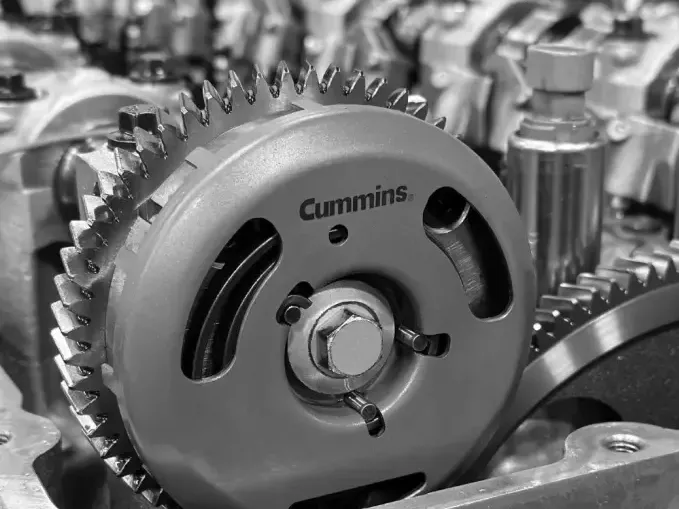

Cam phaser technology
Controls intake and exhaust valve timing
actively with infinite controllability
Can eliminate or reduce dependency
on intake or exhaust throttles with proper use
Effective CO2 and NOx management technology
Jacobs cam phaser with engine braking
Experience the precision of a cam phaser working seamlessly with an engine brake system featuring hydraulic lash adjusters (HLAs), engineered specifically for the demands of commercial vehicles.
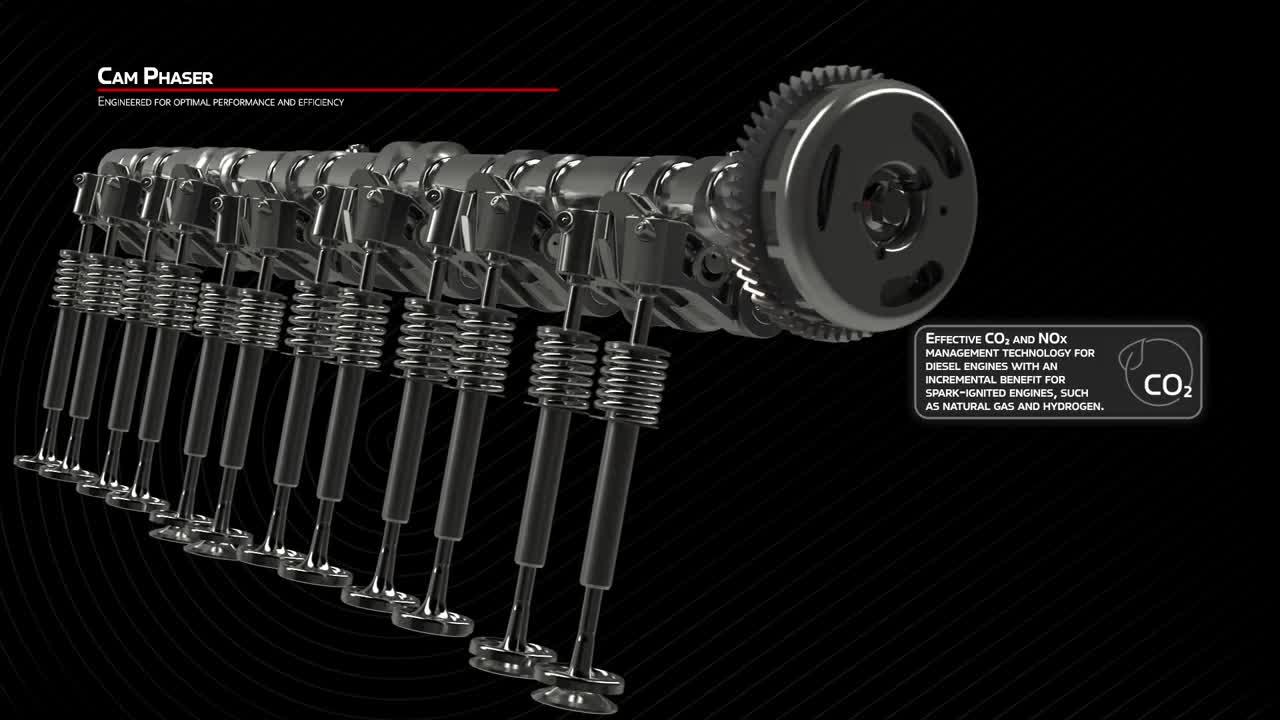
Packaging
Available for multiple configurations of the engine valvetrain, packaging and desired function Compatible with all other Jacobs® technologies including engine braking, cylinder deactivation and lashless Designs for single and double overhead cam applications, as well as Type 2 and Type 3 valvetrain configurations Developed in exclusive partnership with well-known cam phaser and valvetrain technology company Metier Technologies (formerly Mechadyne)
EXPANDFeatures
Intake Lift Modulation
- Typically used to achieve Miller cycle to modify the effective compression ratio of the engine for improved efficiency
- The ability to infinitely vary the valve timing allows the efficiency to be actively controlled in all drive cycles and applications
- Improves fuel consumption by up to 5%
Exhaust Lift Modulation
- Exhaust valve lift modulation used for thermal management including “get-it-hot fast” and “keep-it-warm” strategies
- Infinite controllability on exhaust valve timing allows modulation of exhaust enthalpy to prevent thermal runaway
- Can be used in conjunction with a Jacobs Engine Brake® for performance modulation and optimization throughout the RPM range
Internal EGR
- Intake and exhaust valve overlap can be modulated to achieve varying levels of internal EGR
- Better transient response compared to external EGR systems
- Able to drive EGR at low load conditions when external EGR is not as effective
- Can reduce dependency on problematic external EGR systems and throttles
- Allows reduction of external plumbing for EGR systems
Let's Connect
Get in touch with your customers to provide them with better service. You can modify the form fields to gather more precise information.